

In less than a year, Google made scraping 10× harder. Now its result links point at Google, not the site.
Two changes in under a year, both invisible to people. First Google killed the shortcut that returned 100 results in one request, making every tool work ten times as hard. Now every result link points at a google.com/goto redirect instead of the site, so the exact page a result leads to is no longer sitting in the link. I checked 493 links to see what that hides, what it doesn't, and what it means for the tools that read Google.
What Google changed this month
Search for anything. Hover over a result and look at the bottom-left of your browser. The link used to show the website's address. Now it shows google.com/goto followed by a long string of random-looking characters.
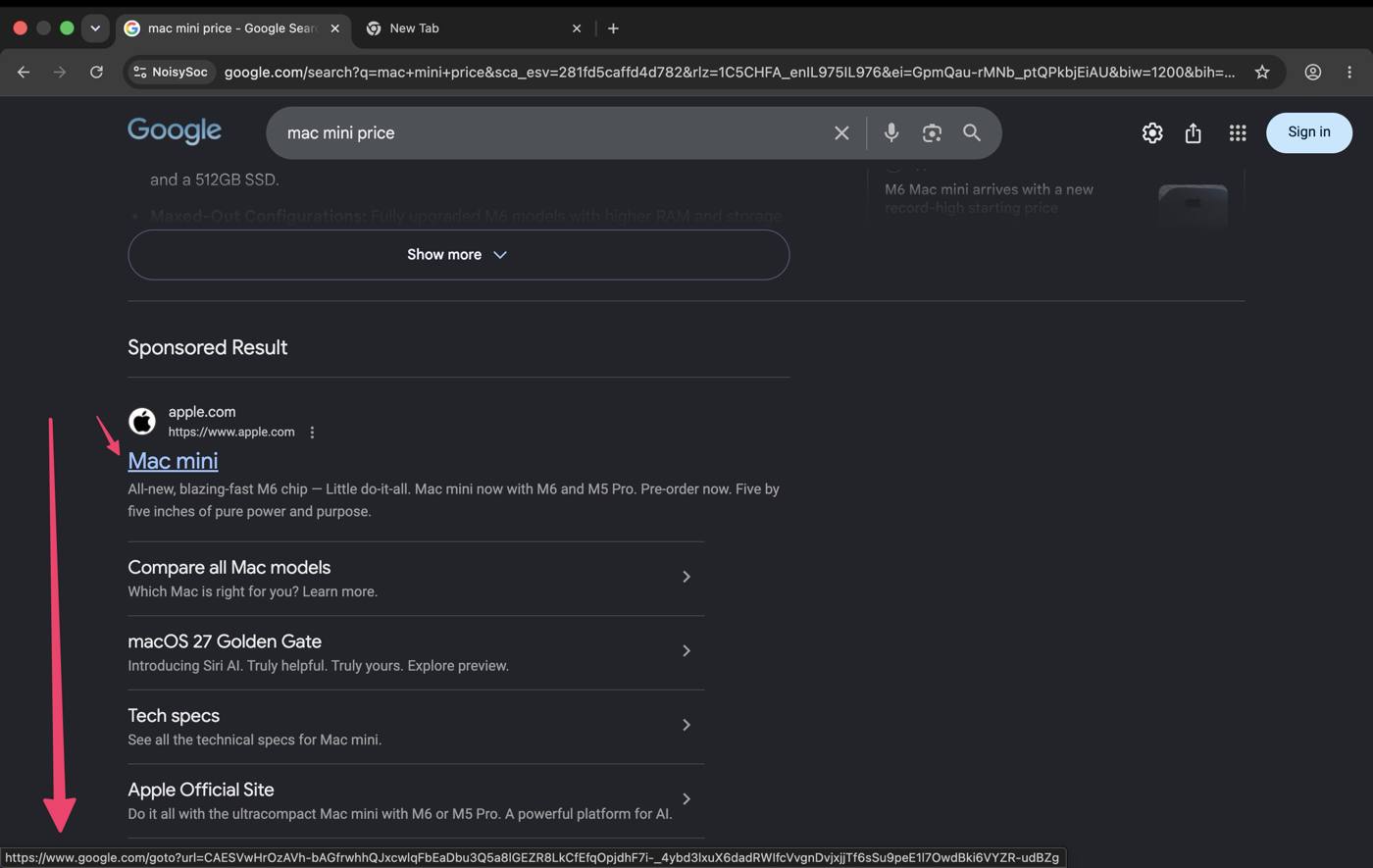
One thing to note before you go looking: this isn't everywhere yet. Every test here is from a US connection, and that's where I've seen it. If you're elsewhere, you may still see normal links for now.
Click it and you still land on the right page. Google reads that string, works out where you meant to go, and sends you there. You'd never notice.
Google's only comment was that it's a "technical measure against abuse." So I tested it. Eight searches, every link on every page, 493 in total. Normal results, videos, AI Overview sources, "People also ask," ads. Every single one hid its destination.
What Google hid, and what it left alone
Here's the part most coverage has missed. Google didn't hide the whole result. It hid the link and left the text around it alone.
The site's name is still printed under every result, in plain text. So is its position. A tool asking "does my site rank, and where?" reads the page once and has its answer, exactly as before.
What's hidden is the working link itself. The grey line under a title still shows the domain and the start of the path, but it's display text: it gets shortened with "..." on longer addresses, and it isn't something you can follow. The full, exact address now sits inside the goto string, and the reliable way to get it is to open the link and let Google forward you.
For a tool tracking domains, the visible line is enough, same as before. For anything that needs exact, complete URLs at scale, each goto link is an extra resolution step that didn't exist in July.
How hard is that step? That depends on the tool, and the encouraging news is that the providers who supply most of this data say they've already handled it.
DemandSphere, which runs rank tracking and a SERP API that other platforms build on, posted the day after Google confirmed the change that its countermeasures are already deployed and that organic ranking data is unaffected: share of voice, competitor attribution, and its other metrics keep working as before. DataForSEO told customers the same week (I'm on the list) that a fix went out on July 5 and that 99.99% of organic results through its API already carry direct destination URLs. Neither says how the resolving works.
So for anyone buying data from the big providers, organic tracking carries on. What's still in progress is the harder part. DemandSphere notes it's still rolling the same fix out to SERP-feature links, and DataForSEO says goto links still show up in about half of AI Overviews and a quarter of Local Packs. Those are exactly the surfaces with many varied links per result, and they're where tool data will be patchiest for a while.
Google's first move, a year ago
For years, tools had a shortcut. Add &num=100 to the end of a Google search and you'd get the top 100 results on one page. One request, everything you needed.
Google switched it off. Reports started around September 10, 2025, and within days the shortcut was gone for good. Pages were capped at 10 results, so getting the top 100 meant loading 10 pages. Google didn't put out a product-blog post. They've said they don't formally support the parameter, and they never explained the timing.
Search Engine Journal reported rank trackers breaking that week. One vendor called it a 10× cost increase overnight.
If you use SEO tools, you felt this even if you didn't know why. Many tools quietly stopped looking past page one or two. That created a strange illusion: a page that still ranks at #45 now shows up as "not found," and average-position charts fall off a cliff even though nothing actually moved. You didn't lose rankings. Your tool lost sight of them.
Site owners felt it too, without knowing why. Search Console filled up with the same question that September: impressions fell off a cliff, clicks stayed flat, and average position somehow improved.
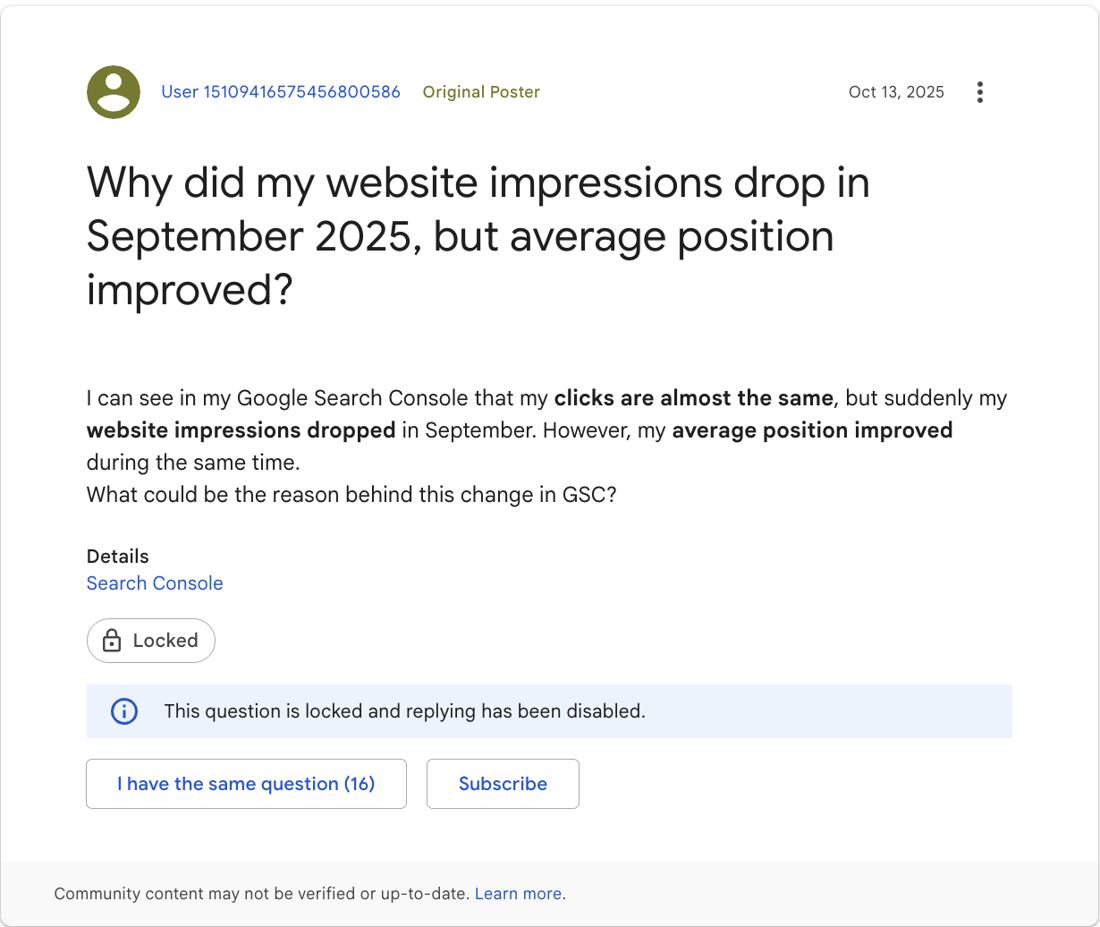
num=100.The SEO community's explanation, which Google has never confirmed, is that many of those impressions came from tools loading 100-result pages rather than from people, so when the tools stopped, the numbers fell.
That's probably part of it, but it isn't the whole story. Google later disclosed a separate logging error that misreported impressions from May 13, 2025 until April 27, 2026. So impression data from that period had at least two sources of distortion, and Google won't be reconstructing it. Clicks were unaffected either way.
That was the first move.
The two moves, side by side
The same job — collect the top 100 with real URLs — in three eras
The first move multiplied everyone's page loads by ten. The second doesn't add a fixed amount; it adds a per-link cost that never fully settles, because every result you want the real URL for is one more request, and how each one is priced depends on how much Google trusts you.
Move two is narrower and softer. The third lane is the ceiling, not the bill: it assumes every link must be resolved individually, and vendors with trusted infrastructure resolve them more cheaply than that. The floor is zero, if the visible domain is all you need. Where a given tool lands between those depends on what it collects and how Google treats its traffic, and vendors don't publish either.
The companies that need the exact page are the ones selling Google's results as data, and the AI products that fold those results into their own answers. They're the ones paying for this.
And requests aren't the whole bill. Every extra request is one more chance to be flagged and blocked, and Google decides per requester how much scrutiny each one gets. Move one multiplied the exposure by ten for everyone. Move two multiplies it again for anyone who has to resolve links individually.
Vendors will find routes around parts of this, and some already have. But the direction is clear: the cheap way in is closing, and the remaining routes cost more for anyone who needs the exact URL.
Google could have just blocked scrapers. But blocking breaks things for real people too. Making one kind of data slowly more expensive doesn't.
Back in September, one SEO commentator predicted that aggressive scraping by AI products would push Google to fight back, and that SEO tools would get caught in the crossfire.Ryan Jones, paraphrased from LinkedIn via Search Engine Journal
The same week, Google posted a job for a "Senior Engineering Analyst, Search, Anti-scraper." The listing asked for someone to measure scraper impact, help design new anti-scraper rules, and build intelligence on who scrapes Google and why. It was closed within a week.
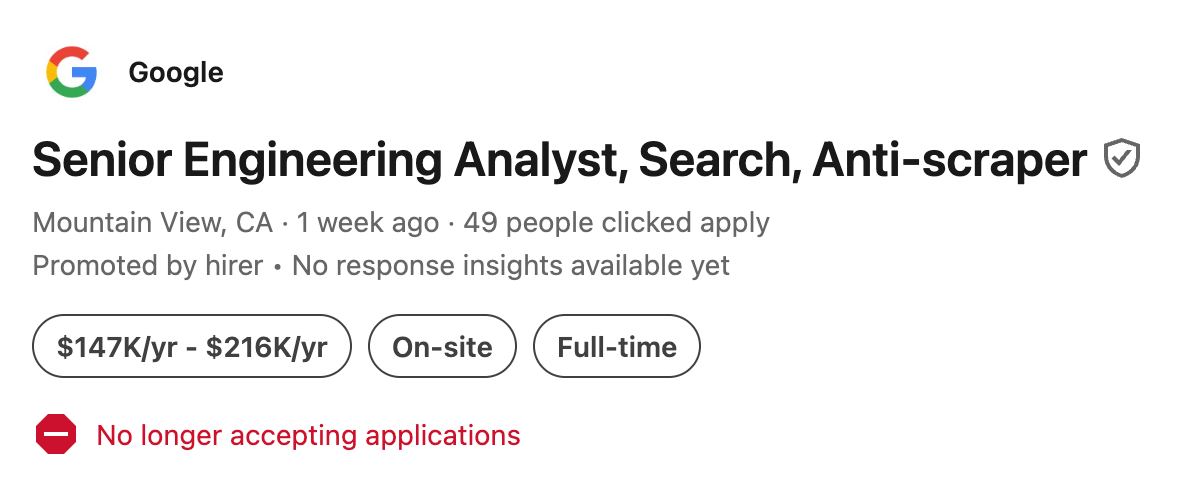
So Google was hiring someone to fight scrapers the same week it took away the shortcut, and eleven months later it hid the links. Both changes are aimed at machines and invisible to people, which looks like a plan, though I can't prove there was one.
Questions people are asking
Does this break my website's analytics?
No. I clicked a result and recorded what the website saw. The visitor came from https://www.google.com/, exactly as before. Google Analytics still says "Google / organic." Search Console is unaffected too.
Is Google using the new links to track me?
I can't say for certain, because I can't read what's inside the link. Two things I did observe: the string grows by roughly one character for every character of the destination URL, so there's little room for anything else, and a browser with no cookies got the same kind of link as a logged-in one. Google also already puts a visible click ID on every result, so a hidden one would add nothing new.
Can a tool work out the URL without opening the link?
Not by decoding it. The string isn't the URL in disguise; you can't reverse it with base64 or any other standard transformation, which is what made Bing's version of this trivial to undo. Following the link is the way, and how cheap that is varies with the tool. The big data providers say they've already automated it for organic results; the trickier cases are SERP features like AI Overviews, which they're still working through.
I just want to know if my site ranks. Does any of this affect me?
Last September's change affects you more than this month's. Google now shows 10 results per page instead of 100, so a tool has to load ten pages to see the top 100. Some tools stopped after page one or two to save money, which is why a page still sitting at #45 can show up in your reports as "not ranking."
This month's change hides the full URL, not whether your site ranks. The site name, and usually the start of the path, are still visible under every result, so that part costs a tool nothing extra.
Is this everywhere?
Not that I can confirm. Everything here was tested from a US connection in late August 2026. Readers elsewhere may still see ordinary links.