
LinkedIn Pulse Lost 85% of Its Organic Traffic in the Last Two Years. Here's What Killed It.
Yuval Halevi · February 2026 · 9 min read · Data: Ahrefs
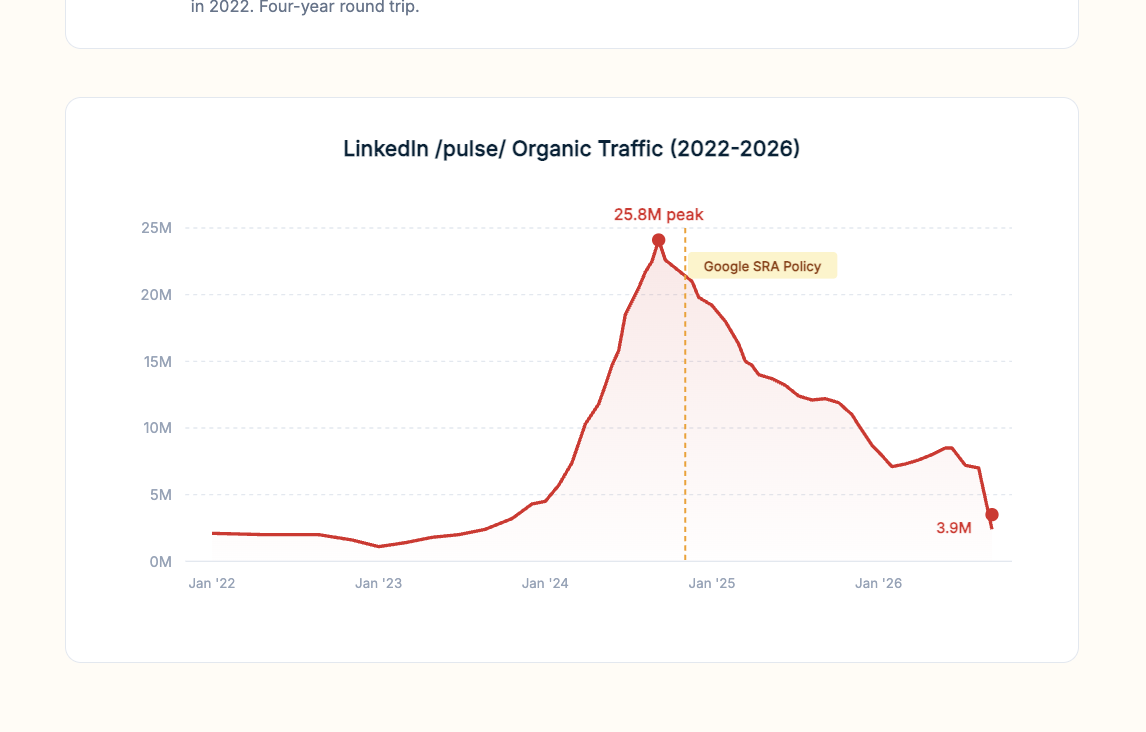
LinkedIn Pulse went from 25.8 million monthly organic visits to 2.4 million in under two years. The reason is simple: people discovered they could publish anything on Pulse and ride LinkedIn's authority straight to page one. Nudifiers, gambling apps, pirated APKs. Google eventually noticed.
I pulled Ahrefs data on every major LinkedIn subdirectory from January 2022 to February 2026 to see what actually happened: what sections grew, what sections died, and what the top-ranking Pulse pages really looked like at the peak.
TL;DR
- LinkedIn /pulse/ dropped from an estimated 25.8M (March 2024 peak) to ~3.9M monthly organic visits (down ~85%)
- 6.3 million indexed Pulse pages shrank to 481K (down 92%)
- Top Pulse pages at peak: AI nudifiers, sex chat bots, pirated Minecraft APKs, leaked celebrity nudes
- LinkedIn /advice/ (collaborative articles) fell even harder: 960K to 37K (down 96%)
- LinkedIn /posts/ (native feed) grew 180% over the same period
- Google's site reputation abuse policy (May 2024) was the kill shot
All traffic figures in this study are third-party estimates from Ahrefs, measuring US organic search visibility only. These are modeled estimates based on keyword rankings and click-through rate models. They are not actual visitor counts. Ahrefs does not capture direct visits, app traffic, newsletter referrals, or any non-search channel. LinkedIn knows its real numbers; we don't. Ratios and directional trends are more reliable than specific counts. February 2026 figures are from a mid-month pull; January 2026 numbers are more conservative and used where precision matters.
Mar '24 → Jan '26
6.3M → 481K
960K → 37K
2.5M → 7.0M
The Timeline: How Pulse Went From 2M to 26M to 2M
The data tells a three-act story. In early 2022, LinkedIn Pulse was a modest section doing about 2 million organic visits per month. Then something changed around mid-2023.
| Date | /pulse/ Traffic | Indexed Pages | Phase |
|---|---|---|---|
| Jan 2022 | 2.1M | - | Baseline |
| May 2023 | 3.7M | - | Steady |
| Jul 2023 | 6.4M | - | ↑ Surge begins |
| Oct 2023 | 10.6M | - | ↑ 5x baseline |
| Dec 2023 | 15.6M | - | ↑ 8x baseline |
| Mar 2024 | 25.8M | 6.3M | ↑ Peak (13x baseline) |
| May 2024 | 20.1M | 6.2M | ↓ Google SRA policy enforced |
| Sep 2024 | 10.5M | 4.8M | ↓ -59% from peak |
| Jan 2025 | 9.3M | 4.5M | ↓ Continued decline |
| Jul 2025 | 5.8M | 2.6M | ↓ -77% from peak |
| Nov 2025 | 3.4M | 777K | ↓ Mass de-indexing |
| Jan 2026 | 3.9M | 481K | ↓ -85% from peak |
| Data: Ahrefs Site Explorer, prefix mode. Pre-2024 data points (Jan 2022–Dec 2023) are from an earlier Ahrefs snapshot and cannot be re-verified via API, which only returns ~2 years of prefix-mode history. Jan 2026 is used as the current endpoint (complete month). February 2026 mid-month pull was excluded as an endpoint due to incomplete data. Updated: April 2026 | |||
The surge from May 2023 to March 2024 wasn't organic growth. It was an influx of content from people who discovered that anything published under linkedin.com/pulse inherited LinkedIn's DR 99. A Pulse article about payday loans ranks faster than a payday loans site with years of backlinks. That's the economics that drove the abuse.
What Was Actually Ranking on LinkedIn Pulse
This is the part nobody talks about with data. I sorted every Pulse page by organic traffic at the March 2024 peak. Here are the top 20 pages on "the world's largest professional network."
| # | Top Keyword | Monthly Traffic | Category |
|---|---|---|---|
| 1 | daman app (gambling) | 317K | Gambling |
| 2 | 8171 ehsaas program | 287K | Benefits scam |
| 3 | blooket join | 278K | Gaming |
| 4 | gk questions with answers | 172K | Trivia spam |
| 5 | birthday wishes for sister | 160K | Greeting card spam |
| 6 | bing image creator | 153K | Tech (legitimate) |
| 7 | hdhub4u (piracy site) | 129K | Piracy |
| 8 | abraham quiros villalba | 113K | Celebrity |
| 9 | nudify (AI nudifier tools) | 104K | NSFW / Deepfake |
| 10 | sex ai (AI sex chat bot) | 100K | NSFW |
| 11 | ai nude generator | 96K | NSFW / Deepfake |
| 12 | payday loans eloanwarehouse | 91K | Predatory lending |
| 13 | general knowledge questions | 87K | Trivia spam |
| 14 | instagram private account viewer | 87K | Hacking tool |
| 15 | birthday wishes for wife | 83K | Greeting card spam |
| 16 | brian peck | 81K | Celebrity |
| 17 | brooke monk naked (leaked nudes) | 78K | Explicit / Leaked |
| 18 | minecraft 1.20 APK | 77K | Piracy |
| 19 | classroom 6x (unblocked games) | 68K | Gaming |
| 20 | undress ai | 68K | NSFW / Deepfake |
| Data: Ahrefs Site Explorer, top pages sorted by organic traffic, www.linkedin.com/pulse/ prefix, date set to March 2024. Traffic figures are Ahrefs estimates, not actual visit counts. Updated: February 2026 | |||
Out of the top 20 highest-traffic LinkedIn Pulse pages, exactly one was arguably legitimate tech content (Bing Image Creator). The rest: three deepfake/nudifier tools, a sex chatbot guide, leaked celebrity nudes, pirated APK downloads, gambling apps, predatory loan affiliates, Instagram hacking tools, and greeting card spam.
This is what a DR 99 domain looks like when anyone can publish on it with zero editorial review. The same dynamic played out on Forbes Advisor and CNN Underscored, where outsourced content rode borrowed authority until Google's Site Reputation Abuse policy ended the model.
Almost every page in that top 20 now shows null traffic in Ahrefs. They've been either de-indexed by Google or removed by LinkedIn. The "birthday wishes for wife" page dropped from 83K monthly visits to 4,400. The nudifier pages simply vanished.
The Collaborative Articles Graveyard

LinkedIn's /advice/ section (collaborative articles) had a different origin but the same ending. These weren't user-published spam. LinkedIn itself generated AI-written questions like "What do you do if your team's presentation skills need improvement?" and invited professionals to contribute short answers.
The pitch was clever: contribute, earn a "Top Voice" badge, get visibility. But the content was thin by design. AI-generated prompts with crowdsourced two-paragraph answers, all riding LinkedIn's DR 99 into Google's top results for thousands of professional queries.
A typical LinkedIn /advice/ page — AI-generated prompt with crowdsourced snippets
| Date | /advice/ Traffic | Indexed Pages | Change from Peak |
|---|---|---|---|
| Mar 2023 | 1,782 | - | Launch |
| Sep 2023 | 847K | - | ↑ Rapid growth |
| Apr 2024 | 959K | 320K | Peak |
| Jan 2025 | 441K | 282K | -54% |
| Jul 2025 | 168K | 344K | -82% |
| Oct 2025 | 58K | 174K | -94% |
| Feb 2026 | 37K | 38K | -96% |
| Data: Ahrefs Site Explorer, prefix mode. Updated: February 2026 | |||
From zero to 959K monthly visits in 13 months. Then back to 37K in 22 months. The section went from 320K indexed pages to 38K. Google didn't just devalue the content. It removed most of it from the index entirely.
The collaborative articles were technically AI-generated with human "contributions," but the contributions were often brief, generic, and added to earn badges rather than to inform. Google's March 2024 core update targeted exactly this pattern: scaled content that uses domain authority as a ranking crutch rather than topical expertise.
What's Actually Growing: The Subdirectory Comparison
Here's the part that matters for anyone building on LinkedIn. Not everything declined. While Pulse and /advice/ collapsed, LinkedIn's native posts section quietly grew.
| Section | Type | Peak Traffic | Jan 2026 | Change |
|---|---|---|---|---|
| /pulse/ | Open UGC publishing | 25.8M | 3.9M | -85% |
| /advice/ | AI-generated + crowdsourced | 960K | 44K | -95% |
| /jobs/ | Job listings (curated) | 6.9M | 3.0M | -56% |
| /posts/ | Native feed posts | 2.5M (Feb '24) | 7.0M | +180% |
| /company/ | Company pages | 17.5M | 12.7M | -27% |
| /in/ | Personal profiles | 18.4M | 10.2M | -44% |
| Data: Ahrefs Site Explorer, prefix mode. /in/ and /company/ declines consistent with industry-wide AI Overview impact. Updated: February 2026 | ||||
The pattern is clear. LinkedIn's core product sections (company pages, profiles) declined moderately, consistent with the industry-wide traffic loss from AI Overviews and zero-click search. LinkedIn itself has acknowledged a 60% decline in non-brand B2B topics. But the sections that were exploitable for parasite SEO (Pulse and collaborative articles) didn't just decline. They were destroyed.
The /posts/ section stands out. Native LinkedIn feed posts grew from 2.5M to 7.0M estimated monthly organic visits over the same period. One possible reading: Google is rewarding authentic social content while punishing open publishing platforms that were gamed. A more cautious reading: as Pulse pages get de-indexed, some of that query traffic may simply reclassify to other LinkedIn sections. The direction is clear; the cause is less so.
Sections with editorial control or natural user generation (/posts/, /company/, /in/) survived. Sections where anyone could publish long-form content with zero gatekeeping (/pulse/, /advice/) got nuked.
The Mechanics of the Abuse
The playbook was simple. LinkedIn has a domain rating of 99 in Ahrefs, rank #5 globally. Publishing a Pulse article gave you a page on a DR 99 domain with zero effort. No backlinks needed. No domain age. No topical authority. Just sign up, write (or have GPT write), and publish.
In the SEO world, this became known as "parasite SEO." You're parasitically using someone else's domain authority to rank content that your own site could never rank. The economics were irresistible:
Lily Ray, a well-known SEO researcher, tested this in March 2025. She published a Pulse article about Google Discover and ranked #1 for "Google Discover Optimization 2025" within six hours. Her reaction on X: "This is so dumb, I can't believe it actually works." That confirmed what the data already showed: the authority transfer was real and nearly instant.
The problem wasn't that people published professional articles on LinkedIn (that was always the point of Pulse). The problem was that the volume of off-topic, spammy, and outright harmful content overwhelmed the legitimate uses. When 3 of your top 20 pages are about AI nudifiers and another is leaked celebrity nudes, Google has no choice but to act.
Google's Response: The Site Reputation Abuse Policy
Google announced its site reputation abuse (SRA) policy in March 2024 and began enforcement in May 2024. The policy specifically targeted content published on high-authority domains with little editorial oversight from the host site, primarily to exploit ranking signals.
The enforcement came in two waves. First, manual actions against the most egregious cases: Forbes Advisor, CNN Underscored, WSJ Buy Side, and coupon sections across European publishers. Then algorithmic devaluation that caught the long tail, including LinkedIn Pulse.
LinkedIn wasn't given a public manual action like Forbes. Instead, the decline was gradual and algorithmic. Google simply stopped trusting Pulse pages at scale. The de-indexing accelerated through 2025: from 6.3M indexed Pulse pages in April 2024 to 481K by February 2026.
The sharpest drops in indexed Pulse pages came in two waves: June-September 2025 (from 2.7M to 2.0M pages) and September-November 2025 (from 2.0M to 777K pages). This aligns with Google's site reputation abuse enforcement and the June-July 2025 core update, which specifically targeted UGC and photo/media catalogs on large platforms.
What This Means If You Published on Pulse
If you have legitimate Pulse articles (actual thought leadership, not affiliate spam), the picture is mixed. LinkedIn Pulse still carries about 3.9M estimated monthly organic visits, so some pages still rank. But the odds are worse than they were, and getting worse monthly.
The practical takeaways:
Native LinkedIn posts now outperform Pulse for Google visibility. The /posts/ section went from 2.5M to 7.0M monthly organic visits while Pulse dropped ~85%. If you want Google to index your LinkedIn content, a well-crafted native post appears to be the better vehicle in 2026.
LinkedIn Newsletters appear unaffected. Newsletters live under a different URL structure and carry explicit subscriber relationships, which may signal legitimacy to Google in ways that open Pulse publishing does not.
The "publish on LinkedIn for backlinks" strategy is dead. The pages that survived are ones with legitimate engagement, real comments, and actual topical relevance. If your Pulse article was just a republished blog post with affiliate links, it's probably already gone from the index.
LinkedIn itself has moved on. In January 2026, LinkedIn published "How LinkedIn Marketing Is Adapting to AI-Led Discovery," explicitly acknowledging that traditional SEO-driven traffic has declined by up to 60% for B2B topics. Their new strategy focuses on AI citations and brand visibility rather than organic search traffic.
Limitations
- Ahrefs estimates are directional, not exact. The absolute numbers have margins of error. Ratios and trends are more reliable than specific traffic counts.
- February 2026 data is incomplete (mid-month pull). January 2026 numbers are more reliable for "current" comparisons.
- Correlation vs. causation: The decline in /pulse/ overlaps with the overall industry-wide traffic decline from AI Overviews. Not all of the 90% drop is attributable to Google's SRA policy alone.
- The /posts/ growth could be partially artificial. As Pulse pages get de-indexed, some of that traffic may simply shift to other LinkedIn sections ranking for similar queries.
- I don't have access to LinkedIn's internal data. Server-side metrics might tell a different story than Ahrefs' crawler-based estimates.
- Selection bias in the top 20 abuse table. The most abusive pages were also the highest-traffic pages, which overstates the proportion of spam in the overall Pulse corpus. Many legitimate articles existed but ranked lower.
Estimated monthly organic visits. Watch how /pulse/ rises and falls.

The Bottom Line
LinkedIn Pulse was a DR 99 playground that got treated like a DR 99 playground. People published nudifiers, gambling apps, and pirated APKs because the platform let them, and Google ranked it because the domain authority was real. That's not a LinkedIn problem or a Google problem. It's a system design problem.
When you give unrestricted publishing access on a top-5 domain globally and layer it with zero editorial review, you get 6.3 million indexed pages, of which the top-performing ones include "AI sex chat bots" and "leaked celebrity nudes." The only surprising thing is that it took Google until 2024 to act.
The surviving sections of LinkedIn (profiles, company pages, native posts) tell us what Google actually values: content that's tied to real identities, real companies, and real social engagement. Not articles published by anonymous accounts riding domain authority to page one.
Pulse isn't dead. But its days as an SEO shortcut are over.

Yuval Halevi
Helping SaaS companies and developer tools get cited in AI answers since before it was called "GEO." 10+ years in B2B SEO, 50+ cybersecurity and SaaS tools clients.
Related Articles
People Search 'Twitter' 30x More Than 'X'
We queried Ahrefs for 50 keyword pairs comparing 'Twitter' vs 'X' search volume.
Technical SEOChatGPT's Favicon Is Missing from Google Search Results
Instead of OpenAI's logo, you'll see a generic globe icon.
SEO Case StudyDigital Ocean SEO Analysis: How They Got Millions of Readers
How Digital Ocean got millions of monthly readers by understanding developers.